Curriculum and Pedagogy
The School of Business follows a dynamic, forward-looking curriculum designed to meet the evolving needs of the industry and prepare learners for success in the 21st-century workplace. Our teaching pedagogy is built around the 4 Cs of Higher Education—Critical Thinking, Creativity, Collaboration, and Communication—ensuring that students graduate as competent, confident, and innovative business professionals.
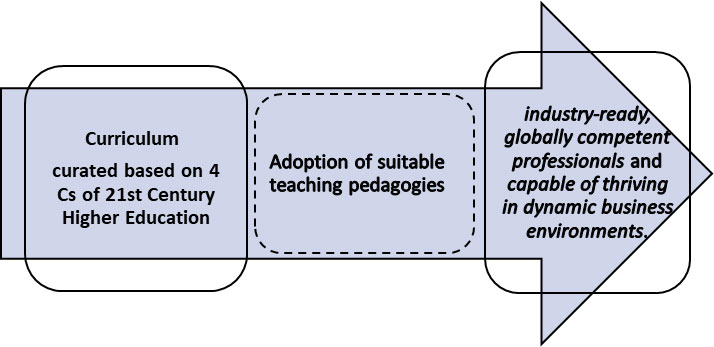
What happens at School of Business
Curriculum Designed for Real-World Relevance
Our programmes blend academic rigor with practical application. Each curriculum is continuously updated in consultation with industry experts, ensuring alignment with emerging trends in management, analytics, banking, finance, entrepreneurship, and digital business models. The curriculum emphasizes:
Strong conceptual foundations
- Analytical and decision-making abilities
- Industry-focused electives
- Multi-disciplinary thinking
- Ethical and value-based learning
The flexibility of Dual Specialization in MBA and diverse BBA specializations allows students to customize their learning pathway for career readiness.
Teaching Pedagogy Aligned with the 4 Cs of 21st-Century Education
1. Critical Thinking: Students are encouraged to question, analyze, evaluate, and interpret information through:
- Case-based Learning (Harvard Method)
- Business Simulations & Gamified Learning
- Problem-Solving Workshops
- Live Projects & Industry Assignments
- Research-Based Learning and Mini Research Projects
These approaches help learners understand real business problems and make data-driven decisions.
2. Creativity: To nurture innovation and entrepreneurial thinking, the School integrates:
- Design Thinking Workshops
- Innovation Labs & Idea Pitching Platforms
- Business Model Canvas Activities
- Creative Assignments, Videos, and Role Plays
- Entrepreneurship Development Cell Activities
Students are encouraged to imagine new solutions and experiment with ideas beyond conventional boundaries.
3. Collaboration: We believe learning is stronger when done together. Students build teamwork and leadership skills through:
- Group Projects and Collaborative Learning Modules
- Peer-to-Peer Learning & Mentoring
- Industry–Academia Collaborations
- Student Clubs (Finance Club, HR Club, Marketing Club, Movie Club, Debate Club)
These initiatives develop interpersonal skills, cultural sensitivity, and the ability to work effectively in diverse teams.
4. Communication: Strong communication is essential in management. The curriculum integrates multiple avenues to help students express, persuade, and present effectively:
- Presentation Skills & Public Speaking Sessions
- Business Communication Labs
- Group Discussions, Debates & Panel Interactions
- Report Writing, Research Presentations
- Soft Skills and Personality Development Workshops
This holistic training prepares students for interviews, corporate interactions, and leadership roles.
Innovative Pedagogies at the School of Business
- Our faculty uses a mix of modern, student-centric pedagogies, including:
- Flipped Classroom
- Blended Learning (Online + Offline)
- Learning Management Systems (LMS) for digital resources
- Industry Expert Lectures & Masterclasses
- Internships, Field Projects, CSR Projects
- Technology-enabled learning tools
- Industrial Visits and Study Tours
These teaching methods ensure that students develop practical exposure, digital competence, and workplace readiness.
Outcome: Future-Ready Graduates
Through a well-designed curriculum and innovative pedagogy, the School of Business equips students with:
- Leadership and managerial skills
- Analytical and decision-making ability
- Creative problem solving
- Ethical and socially responsible thinking
- Strong communication and teamwork abilities
- Digital and analytical skills for the future workplace
|